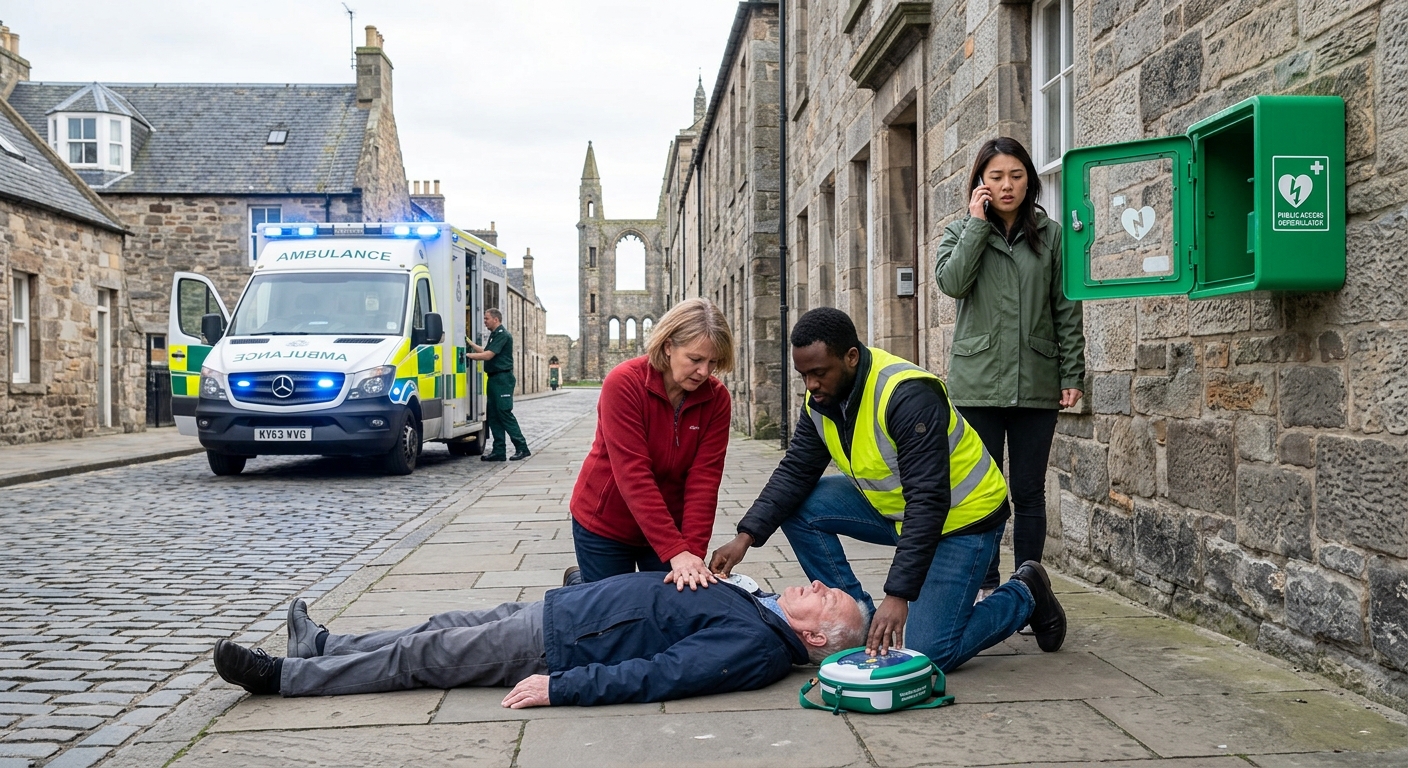
Our Community Public Accessible Defibrillator programme started around 2008. You may have noticed the green or yellow boxes around St Andrews and the North East of Fife.
We currently have 27 AEDs around the town of St Andrews.
We also have the same number of AEDs in surrounding communities.
These are all held on a database The Circuit and visible to the Scottish Ambulance Service. When you dial 999 their map will show the nearest defibrillator and they will guide you to it.
Each of our defibrillators are in an unlocked cabinet, usually on an external wall and are available 24/7. Each one is maintained by a volunteer guardian who conducts weekly and monthly checks to ensure they are always ready for use.

The map above show all the defibrillators we are responsible for. To find your nearest defibrillator go to Defib Finder
Every week in Scotland, around 70 people have a cardiac arrest at home, work or in a public place.
Starting CPR as soon as possible will give the person the best chance of survival, but being able to use defibrillator within the first few minutes of collapse increases that chance even further.
We have been working and campaigning, since 2008, communities to increase the availability of Public Access Defibrillators in our area .
For the best chance of survival, public access defibrillators (PADs) need to be close to where cardiac arrests happen, ideally within 200m (taking about a 4 min round trip to fetch).
If you are a community group, business, charity or individual looking for support to install a defibrillator in our area, we can help.
We will normally fund up to 50% for the purchase and install of a new cPAD site and bear the responsibility for ongoing costs. If there is a gap in funding, provision or urgent need for a new cPAD site we will consider funding up to 100% of the cost.
Our local knowledge combined with PADmap, an innovative tool designed to optimise the placement of public access defibrillators (PADs). It combines historical data on the distribution of cardiac arrests with the current map of registered defibrillators to identify the most effective new locations for future public defibrillators placement. By using advanced mathematical techniques, we can help save lives by ensuring defibrillators are accessible where they are most needed.
Research has found gaps defibrillator provision and that many of them are not optimally placed. Most cardiac arrests don’t happen near a defibrillator. In addition, those in more socioeconomically deprived communities - who are at highest risk of cardiac arrest - have access to the fewest public defibrillators. An inequality we want to change!